Paper Title :
OVERHAULING COMMERCE EDUCATION IN INDIA
Abstract
Commerce is as old as civilization. No civilized community produces all the things which it consumes. At least a part of the needs are met by exchange of products with other communities or nations. This necessitated the birth of commerce.
Commerce education in India was started by private commercial institutions. To start with, only book-keeping was taught. Munims used to train junior Munims under their apprenticeship. Private commercial institutes started teaching book-keeping and accountancy. Commerce was introduced in higher education more than 100 years ago in the state of Madras in1886. Commerce education at University level was introduced in 1913 when Sydenham college of commerce and economics was established in Bombay and since then there has been a steady increase in commerce courses and related disciplines all over India
The last two decades have witnessed a slump in commerce education in terms of the number of bright students that has gone down significantly. Commerce graduates are neither specialists nor generalists. They are perceived as suitable only for clerical jobs. MBAs, CAs and ICWAs are perceived as suitable candidates for managerial positions. Some issues that aggravate the problem are lack of knowledge about commerce at school level as commerce education is not introduced at school level in many states, it is more content oriented rather than skill and practice oriented, lack of practical exposure both to the teacher and taught (commerce may be the only practical subject which is theoretically taught without practical exposure), obsolete content (syllabus), relative indifference towards courses like marketing, HR, E Commerce, strategic management, indifference towards improvement in communication skills, poor teachers & delivery mechanism.
Commerce education in India needs a complete overhaul. Appropriate modifications and refinements in content and delivery mechanism and an aggressive branding strategy can bring back the glory of this most ancient discipline and change stakeholder perceptions.
Authors
Dr. Amit Joshi
Associate Professor
Kumaun University Campus Bhimtal
Uttarakhand, India
Dr. Saurabh Joshi
Associate Professor
SRH University
Dehradun,Uttarakhand, India.
Nidhi Agarwal
Research Scholar
Kumaun University Campus Bhimtal
Uttarakhand, India

Paper Transcript of Paper Titled :
OVERHAULING COMMERCE EDUCATION IN INDIA
Overhauling Commerce Education in India
Dr. Amit Joshi
Associate Professor
Kumaun University Campus Bhimtal,
Uttarakhand, India.
Dr. Saurabh Joshi
Associate Professor
SRH University,
Dehradun
Uttarakhand, India.
Nidhi Agarwal
Research Scholar
Kumaun University Campus Bhimtal,
Uttarakhand, India
Abstract—Commerce is as old as civilization. No civilized community produces all the things which it consumes. At least a part of the needs are met by exchange of products with other communities or nations. This necessitated the birth of commerce.
Commerce education in India was started by private commercial institutions. To start with, only book-keeping was taught. Munims used to train junior Munims under their apprenticeship. Private commercial institutes started teaching book-keeping and accountancy. Commerce was introduced in higher education more than 100 years ago in the state of Madras in1886. Commerce education at University level was introduced in 1913 when Sydenham college of commerce and economics was established in Bombay and since then there has been a steady increase in commerce courses and related disciplines all over India
The last two decades have witnessed a slump in commerce education in terms of the number of bright students that has gone down significantly. Commerce graduates are neither specialists nor generalists. They are perceived as suitable only for clerical jobs. MBAs, CAs and ICWAs are perceived as suitable candidates for managerial positions. Some issues that aggravate the problem are lack of knowledge about commerce at school level as commerce education is not introduced at school level in many states, it is more content oriented rather than skill and practice oriented, lack of practical exposure both to the teacher and taught (commerce may be the only practical subject which is theoretically taught without practical exposure), obsolete content (syllabus), relative indifference towards courses like marketing, HR, E Commerce, strategic management, indifference towards improvement in communication skills, poor teachers & delivery mechanism.
Commerce education in India needs a complete overhaul. Appropriate modifications and refinements in content and delivery mechanism and an aggressive branding strategy can bring back the glory of this most ancient discipline and change stakeholder perceptions.
Keywords-Branding; Commerce; Management; Overhauling;
Introduction
Human engagements since the beginning of civilization may be broadly categorized into two activities – Public service (including governance) and commerce. People were either engaged in government, administration or any other form of government service or activities that may directly or indirectly be described as commerce.
The origin of commerce is the history of civilization. No civilized community produces all the things which it consumes. At least a part of the needs are met by exchange of products with other communities or nations. This necessitated the birth of commerce.
More than simple trade and barter, commerce as we know it began five millennia ago in Mesopotamia. Sanctified in temples, the attribute of kings, and the enabler of dynasties, the true propulsion behind writing and the law itself, commerce was the driver of urbanization and the catalyst of civilization. Certainly, even if ancient Iraq was not the cradle of civilization according to any who would debate the precedents, it seems to have been the “cradle of commerce.” Perhaps there is no distinction.
The known economic history of India begins with the Indus Valley Civilization. The Indus civilization's economy appears to have depended significantly on trade, which was facilitated by advances in transport.
Formal Commerce Education in Institutes of higher learning/universities
The Bachelor of Commerce degree was first offered at the University of Birmingham. The University’s School of Commerce was founded by William Ashley, an Englishman from Oxford University.
Eighteenth-century economists had divided the English economy into three sectors: agriculture, manufacturing, and commerce. Commerce included the transportation, marketing, and financing of goods. The Birmingham program included economic geography, economic history, general economics, modern languages, and accountancy
Education of commerce in India was started by private commercial institu¬tions. To start with only book-keeping was taught. We find Munims used to train junior Munims under their apprenticeship. Later on private commercial institutes started teaching of book-keeping and accountancy. If we see the history commerce in higer education is nearly 102 years old. For such an education, Madras became a pioneer state where it started in 1886. The Government of Madras laid the foundation of commerce education by setting-up commercial institute in Madras. Two other institutions were established during the next ten years (by 1896). Government of India also started commerce college at Calicut and Presidency college at Calcutta . In India Commerce education at University level made its first beginning in 1913 when Sydenham college of commerce and economics was established by Bombay, since then there has been steady increase in commerce courses and its related branches all over India, there is hardly any university or college which don’t have commerce department.
In the beginning of this century Calcutta Presidency College also introduced the teaching of commerce (1903). By about that time it was also introduced in Delhi. One more commercial institution was started in Bombay in 1912. In 1920's (1921-22) the first Fiscal Commission was set-up and this commission made certain important recommendations In the light of these recommendations some major improvements were vis¬ible in various industrial fields especially in the field of iron and steel industry, sugar industry, tea industry, cotton industry and jute indus¬try.
A very rapid growth of commercial educational institutions was observed during 1920-40. The Indian Institute of Bankers was estab¬lished in 1926, the Institute of Chartered Accountants of India was established in 1934. Later on in 1944, Institute of Works and Cost Accountants of India was established. In 1955, the Federation of Insurance Institutes was established.
Management emerged as a specialized discipline and skimmed Commerce of all it’s charm and glamour. No effort was made to professionalize commerce education, rather it was regarded as the facilitator of other professional courses. Perception of commerce gradually changed and many stakeholders still associate commerce with accountancy & income tax with only a fleeting reference to business studies. The courses are perceived as static and obsolete.
Changing Perception of Commerce
Commerce is usually associated with accountancy & income tax with only a fleeting reference to business studies. Most of the courses may best be described as ‘A postmortem’, an exercise that hardly serves any practical purpose in today’s extremely dynamic environment. The curriculum and teaching methodology is like ‘Crying over spilled milk’. Commerce graduates are neither specialists nor generalists. Commerce graduates in India are in most cases considered suitable only for clerical jobs.
Status of Commerce Education
The status of commerce education in India is discussed on the basis of facts and figures collected from institutions in Uttarakhand, Himanchal Pradesh, Haryana, UP, delhi, Madhya Pradesh and Rajasthan. The information has not been collected formally due to the unwillingness of institutes to share details. Friends and colleagues have provided data and information that has been analyzed. The authors do not claim accuracy of data but indications are very clear and analysis is indicative and not accurate. The primary purpose of this study is to get an insight into the status of commerce education in north India.
There is acute shortage of substantial literature. Perhaps no extensive research has been carried out. However, analysis of business newspapers and magazines have provided valuable inputs.
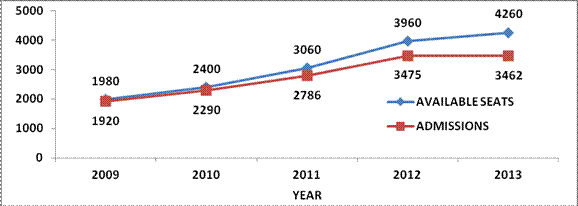
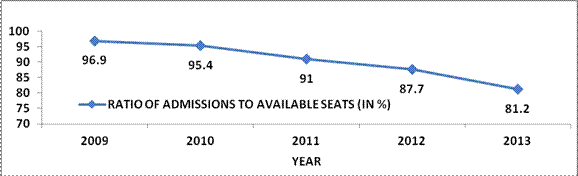
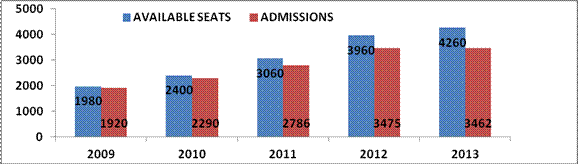
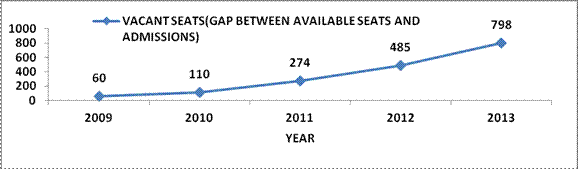
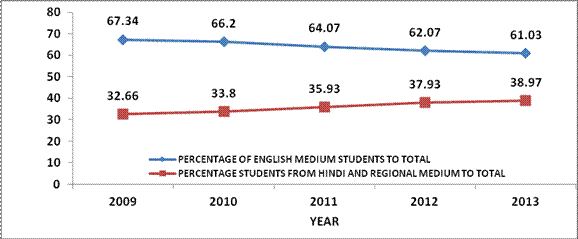
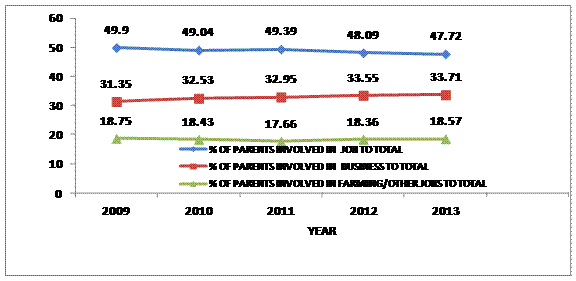
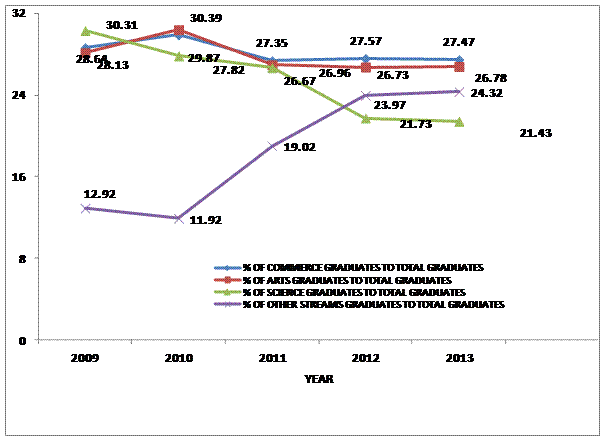
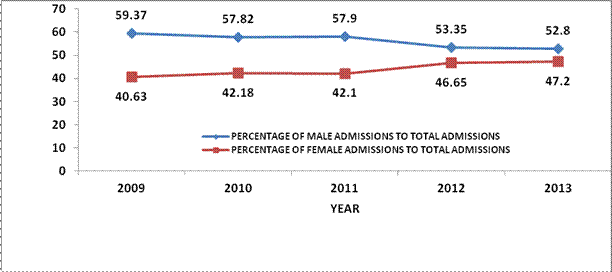
Data collected is analyzed and presented below in the form of tables and graphs:
YEAR |
(A) |
(B) |
(C) |
(D)/ |
COMPARATIVE FIGURES |
||||
A/B |
A/C |
B/C (IN %) |
D/A |
D/B (IN %) |
|||||
2009 |
32 |
1980 |
1920 |
60 |
61.875 |
60.00 |
96.9 |
1.875 |
3.03 |
2010 |
38 |
2400 |
2290 |
110 |
63.157 |
60.263 |
95.4 |
2.894 |
4.58 |
2011 |
48 |
3060 |
2786 |
274 |
63.75 |
58.041 |
91.0 |
5.708 |
8.95 |
2012 |
62 |
3960 |
3475 |
485 |
63.87 |
56.048 |
87.7 |
7.822 |
12.24 |
2013 |
66 |
4260 |
3462 |
798 |
64.54 |
52.454 |
81.2 |
12.09 |
18.73 |
RATIOS TO ASSESS THE RELATIVE PERFORMANCE OF INSTITUTIONS OFFERING COMMERCE COURSES-YEAR BY YEAR (COMPARATIVE FIGURES) |
Total Institutes To Available Seats Ratio |
Total Institutes To Total Admissions Ratio |
Total Available Seats To Total Admissions Ratio |
Total Vaccant Seats To Total Institutes Ratio |
Total Vaccant Seats To Total Intake Ratio |
||||
(A) |
TOTAL NO. OF INSTITUTES |
||||||||
(B) |
AVAILABLE SEATS |
||||||||
(C) |
TOTALADMISSIONS |
||||||||
(D)/ (B-C) |
DIFFERENCE BETWEEN INTAKE AND ADMISSIONS |
||||||||
YEAR |
2009 |
2010 |
2011 |
2012 |
2013 |
2009 |
2010 |
2011 |
2012 |
2013 |
||||||
|
|
|
|
|
R/T (%) |
U/T (%) |
R/T (%) |
U/T (%) |
R/T (%) |
U/T (%) |
R/T (%) |
U/T (%) |
R/T (%) |
U/T (%) |
||
INHABITATION |
RURAL |
552 |
816 |
989 |
1232 |
1241 |
28.75 |
71.25 |
35.63 |
64.37 |
35.50 |
64.50 |
35.45 |
64.55 |
35.85 |
64.15 |
URBAN |
1368 |
1474 |
1797 |
2243 |
2221 |
R/T: % OF STUDENTS FROM RURAL BACKGROUND TO TOTAL U/T: % OF STUDENTS FROM URBAN BACKGROUND TO TOTAL |
||||||||||
TOTAL |
1920 |
2290 |
2786 |
3475 |
3462 |
|||||||||||
YEAR |
2009 |
2010 |
2011 |
2012 |
2013 |
2009 |
2010 |
2011 |
2012 |
2013 |
||||||
|
|
|
|
|
M/T (%) |
F/T (%) |
M/T (%) |
F/T (%) |
M/T (%) |
F/T (%) |
M/T (%) |
F/T (%) |
M/T (%) |
F/T (%) |
||
GENDER |
MALE |
1140 |
1324 |
1613 |
1854 |
1828 |
59.37 |
40.63 |
57.82 |
42.18 |
57.90 |
42.10 |
53.35 |
46.65 |
52.80 |
47.20 |
FEMALE(F) |
780 |
966 |
1173 |
1621 |
1634 |
M/T: PERCENTAGE OF MALE ADMISSIONS TO TOTAL ADMISSIONS F/T: PERCENTAGE OF FEMALE ADMISSIONS TO TOTAL ADMISSIONS |
||||||||||
TOTAL |
1920 |
2290 |
2786 |
3475 |
3462 |
|||||||||||
YEAR |
2009 |
2010 |
2011 |
2012 |
2013 |
RATIOS (IN %) |
2009 |
2010 |
2011 |
2012 |
2013 |
||
|
|
|
|
|
|
|
|
|
|
|
|||
GRADUATION STREAM |
COMMERCE (C) |
550 |
684 |
762 |
958 |
951 |
C/T (IN %) |
28.64 |
29.87 |
|
27.35 |
27.57 |
27.47 |
ARTS(A) |
540 |
696 |
751 |
929 |
927 |
A/T (IN %) |
28.13 |
30.39 |
26.96 |
26.73 |
26.78 |
||
SCIENCE(S) |
582 |
637 |
743 |
755 |
742 |
S/T (IN %) |
30.31 |
27.82 |
26.67 |
21.73 |
21.43 |
||
OTHERS(O) |
248 |
273 |
530 |
833 |
842 |
O/T (IN %) |
12.92 |
11.92 |
19.02 |
23.97 |
24.32 |
||
TOTAL(T) |
1920 |
2290 |
2786 |
3475 |
3462 |
C/T: COMMERCE GRADUATES TO TOTAL GRADUATES |
|||||||
OTHERS REFER TO GRADUATES FROM VIVID STREAMS INCLUDING ENGINEERING, AGRICULTURE, IT ETC. |
|||||||||||||
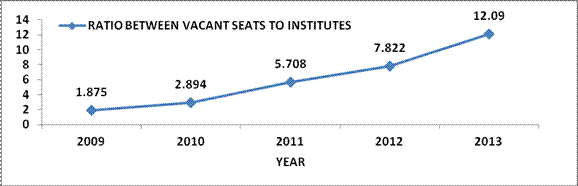
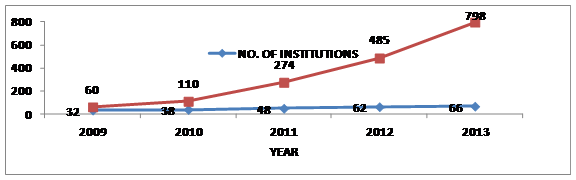
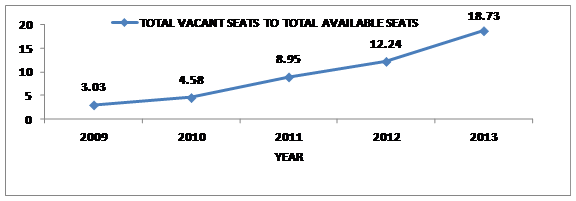
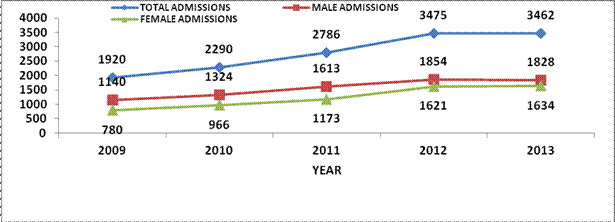
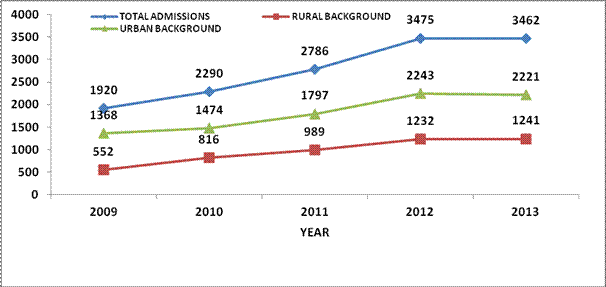
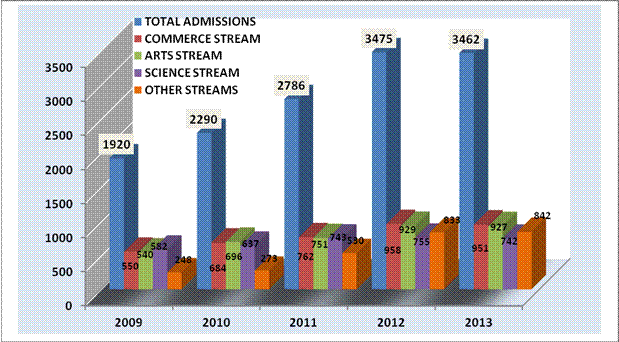
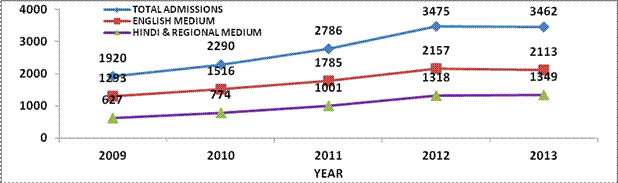
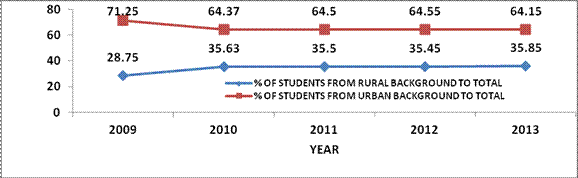
For the purpose of analysis, interpretation, hypothesis testing and operational justification of the statement bivariate correlation has been calculated with the help of SPSS.17 software. Results significant from the point of view of current problem were taken .Rest were ignored. Cells marked in yellow are significant from the analysis perspective.
CORRELATION TABLE A |
|||||
|
|
INSTITUTES |
INTAKE (CAPACITY) |
ADMISSIONS |
GAP |
INSTITUTES |
PEARSON CORRELATION |
1 |
1.000** |
.993** |
.954* |
SIG. (2-TAILED) |
|
.000 |
.001 |
.012 |
|
N |
5 |
5 |
5 |
5 |
|
INTAKE (CAPACITY) |
PEARSON CORRELATION |
1.000** |
1 |
.992** |
.957* |
SIG. (2-TAILED) |
.000 |
|
.001 |
.011 |
|
N |
5 |
5 |
5 |
5 |
|
ADMISSIONS |
PEARSON CORRELATION |
.993** |
.992** |
1 |
.912* |
SIG. (2-TAILED) |
.001 |
.001 |
|
.031 |
|
N |
5 |
5 |
5 |
5 |
|
GAP |
PEARSON CORRELATION |
.954* |
.957* |
.912* |
1 |
SIG. (2-TAILED) |
.012 |
.011 |
.031 |
|
|
N |
5 |
5 |
5 |
5 |
|
**. CORRELATION IS SIGNIFICANT AT THE 0.01 LEVEL (2-TAILED). |
|
|
|||
*. CORRELATION IS SIGNIFICANT AT THE 0.05 LEVEL (2-TAILED). |
|
|
|||
CORRELATIONS TABLE –B |
|||||||
|
|
ADMISSIONS |
|
||||
ADMISSIONS |
PEARSON CORRELATION |
1 |
|
||||
SIG. (2-TAILED) |
|
|
|||||
N |
5 |
|
|||||
COMMERCESTREAM |
PEARSON CORRELATION |
.995** |
|
||||
SIG. (2-TAILED) |
.000 |
|
|||||
N |
5 |
|
|||||
SCIENCESTREAM |
PEARSON CORRELATION |
.925* |
|
||||
SIG. (2-TAILED) |
.024 |
|
|||||
N |
5 |
|
|||||
ARTSSTREAM |
PEARSON CORRELATION |
.987** |
|
||||
SIG. (2-TAILED) |
.002 |
|
|||||
N |
5 |
|
|||||
OTHERSTREAMS |
PEARSON CORRELATION |
.987** |
|
||||
SIG. (2-TAILED) |
.002 |
|
|||||
N |
5 |
|
|||||
**. CORRELATION IS SIGNIFICANT AT THE 0.01 LEVEL (2-TAILED). |
|
|
|
|
|||
*. CORRELATION IS SIGNIFICANT AT THE 0.05 LEVEL (2-TAILED). |
|
|
|
|
|||
CORRELATION TABLE-C |
||||||
|
|
SCIENCEPERCENT |
COMMERCEPERCENT |
ARTSPERCENT |
OTHERSPERCENT |
ADMISSIONS |
SCIENCEPERCENT |
PEARSON CORRELATION |
1 |
.618 |
.610 |
-.936* |
.927* |
SIG. (2-TAILED) |
|
.267 |
.275 |
.019 |
.023 |
|
N |
5 |
5 |
5 |
5 |
5 |
|
COMMERCEERCENT |
PEARSON CORRELATION |
.618 |
1 |
.985** |
-.852 |
.705 |
SIG. (2-TAILED) |
.267 |
|
.002 |
.067 |
.185 |
|
N |
5 |
5 |
5 |
5 |
5 |
|
ARTSPERCENT |
PEARSON CORRELATION |
.610 |
.985** |
1 |
-.849 |
.683 |
SIG. (2-TAILED) |
.275 |
.002 |
|
.069 |
.204 |
|
N |
5 |
5 |
5 |
5 |
5 |
|
OTHERSPERCENT |
PEARSON CORRELATION |
-.936* |
-.852 |
-.849 |
1 |
-.923* |
SIG. (2-TAILED) |
.019 |
.067 |
.069 |
|
.025 |
|
N |
5 |
5 |
5 |
5 |
5 |
|
ADMISSIONSTO TOTAL INTAKE % |
PEARSON CORRELATION |
.927* |
.705 |
.683 |
-.923* |
1 |
SIG. (2-TAILED) |
.023 |
.185 |
.204 |
.025 |
|
|
N |
5 |
5 |
5 |
5 |
5 |
|
*. CORRELATION IS SIGNIFICANT AT THE 0.05 LEVEL (2-TAILED). |
|
|
|
|||
**. CORRELATION IS SIGNIFICANT AT THE 0.01 LEVEL (2-TAILED). |
|
|
|
|||
CORRELATION TABLE-D |
||||||
|
|
URBANPERCENT |
RURALPERCENT |
ENGLISHPERCENT |
HINDIPERCENT |
ADMISSIONSTOINTAKE(%) |
URBANPERCENT |
PEARSON CORRELATION |
1 |
-1.000** |
.681 |
-.681 |
.594 |
SIG. (2-TAILED) |
|
.000 |
.206 |
.206 |
.291 |
|
N |
5 |
5 |
5 |
5 |
5 |
|
RURALPERCENT |
PEARSON CORRELATION |
-1.000** |
1 |
-.681 |
.681 |
-.594 |
SIG. (2-TAILED) |
.000 |
|
.206 |
.206 |
.291 |
|
N |
5 |
5 |
5 |
5 |
5 |
|
ENGLISHPERCENT |
PEARSON CORRELATION |
.681 |
-.681 |
1 |
-1.000** |
.969** |
SIG. (2-TAILED) |
.206 |
.206 |
|
.000 |
.007 |
|
N |
5 |
5 |
5 |
5 |
5 |
|
HINDIPERCENT |
PEARSON CORRELATION |
-.681 |
.681 |
-1.000** |
1 |
-.969** |
SIG. (2-TAILED) |
.206 |
.206 |
.000 |
|
.007 |
|
N |
5 |
5 |
5 |
5 |
5 |
|
ADMISSIONSTOTOTAL INTAKE % |
PEARSON CORRELATION |
.594 |
-.594 |
.969** |
-.969** |
1 |
SIG. (2-TAILED) |
.291 |
.291 |
.007 |
.007 |
|
|
N |
5 |
5 |
5 |
5 |
5 |
|
**. CORRELATION IS SIGNIFICANT AT THE 0.01 LEVEL (2-TAILED). |
|
|
|
|||
Conclusion
The existing institutions of higher learning offering degree courses in commerce have increased the number of seats significantly in the recent past. The number of students admitted to commerce courses has also gone up but has not been able to keep pace with the increased number of seats offered. An increasing number of girls are opting for courses in commerce.
An interesting observation is that a majority of students are from urban region, mostly males, from families where prime occupation of the parents is salaried job and had English as the medium of instruction and communication in school.
The proportion of science students in these institutions has declined.
The majority of students come from the families where the main occupation of the parents is salaried job. The range is between 47% to 49%. This could be because most of the students are from urban areas where majority of parents are occupied in salaried jobs. This is followed by students from the business class family.
The gap between the capacity (available seats) of the institutions and the number of admissions is widening from the year 2007 onwards and peaked in the year 2010.
96 % seats of the total seats offered were occupied in the year 2006. The number has fallen considerably to 81 % by the year 2010. Gap between capacity and admissions was maximum (798) in the year 2010.
Number of the institutions has increased from 32 to 66 within the span of 5 years.
Gap between the percentages of gender wise admissions to total admissions has narrowed down in 2010. Male admissions have come down from 59 to 52 percent and female admissions have increased from 40 to 47% between the years 2006 to 2010.
High degree of positive correlation is observed between the number of institutions and admissions, which shows that with the increment in the number of institutions rate of admissions also increases. Significant degree of positive correlation is seen between intake capacity and admissions too indicating that increment in capacity results in increment of admissions too. High degree of positive correlation can be observed between no. of institutions and gap (vacant seats) indicating that as the institutions increase in number, gap between the institutions and admissions would also increase. Similarly high degree of positive correlation exists between intake capacity/number of seats available and gap, which denotes as the intake increases gap (vacant seats) would also increase. The most significant degree of positive correlation can be observed between admissions of commerce candidates and total admissions. This indicates that students aspiring for commerce courses affect the overall admissions in the institutes. High and significant degree of negative correlation can be observed between the percentage of candidates from other streams over total admissions and percentage of total admissions over total intake. This could mean that students from others category take admissions only when students from the prominent (commerce, science and arts) streams show their disinterest. High degree of correlations (positive and negative both) can be observed between the medium of schooling and total admissions. Percentages of language background at school level to total admissions are highly correlated along with total admissions to total intake thereby indicating that the impact of candidates schooling over admissions to commerce courses cannot be ignored.
A very interesting observation during this study was the fact that stakeholders in commerce education complain that commerce has been robbed of it’s glamour and charm by courses like BBA and MBA that are usually perceived as competitors. Academics in commerce departments and faculties are quite vocal in expressing their anger and resentment over the ‘step motherly’ treatment given to commerce graduated by corporate. Educators in commerce are again almost unanimous with their appeal and resolve to do “something” to bring back the glory of commerce that it once enjoyed as a sought after discipline by students and corporate. Suggestions range from ‘revising the syllabus’, to ‘changing teaching methodologies’ to’ introduce new courses’ and to ‘work closely with corporate’. Simply serving ‘old wine in a new bottle’ will not serve this purpose.
“The old order changed yielding place to the new … “. There seem to be only two options – Accept the change with grace and dignity and let ‘commerce’ manifest itself in newer and better forms, names and content or overhaul the entire system of ‘commerce education’ in tune with the times. ‘Old is Gold’ and old wine is the ‘best’ are just two time tested perceptions that all of us believe to be ‘true’. This perception needs to be induced again in stakeholders’ minds with commerce as a brand. The brand building exercise must be taken up urgently before it is too late.
References
Angehrn A.& Nabeth T.,(1997) "Leveraging Emerging Technologies in Management Education: Research and Experiences”, European Management Journal, Vol.15, No.3, pp.275-285.
Bandyopadhyay R.,(1991))"Indian Management Education: Need for a Constructive Debate",Economic and Political Weekly,Vol.26,No.48,pp.M118-M122.
Baumgartel H.J., Pathan,R., Roy,B., Khandelwal,G. &Rahman,A.,(1984)"Changes in Organisational Climate and Management Education, 1968 to 1981: Some Warning Signals",Economic and Political Weekly,Vol.19,No.8,pp.M15-M21.
Bowonder B. and Rao S.L.,(2004)"Management Education in India its evolution and some contemporary issues ",available at :http://www.aima-ind.org /pdf/ Director_ Conclave_ 9_Paper.pdf (accessed 25 October 2010).
Cornuel E.,(2005)"The role of business schools in society", Journal of Management Development,Vol.24,No.9,pp.819-829.
Crowther D.andCarter,C.,(2002)"Legitimating Irrelevance: management education in higher education in institutions", The International Journal of Educational Management, Vol.16,No.6,pp.268-278.
D'Mello. B.,(1999)"Management Education: A Critical Appraisal", Economic and Political Weekly, Vol. 15, No. 22 (May 31, 1980), pp. Published,Vol.34,No.48,pp.M169-M176.
Dr. Priya A.,(2007)"Global World & Quality of Management Education in India", available at:http://www.indianmba.com/faculty_column/fc631/fc631.html(accessed 25 October 2010).
Engwall. L.,(2007)"The anatomy of management education", Scandinavian Journal of Management,Vol.23,,pp.4–35.
Ganesh, S.R.,(1980)"Performance of Management Education Institutions: An Indian Sampler",Higher Education,Vol.9,No.3,pp.239-253.
Gill A. & Lashine,S.,(2003)"Business education: A Strategic market-oriented focus",The International Journal of Educational Management,Vol.17,No.5,pp.188-194.
MacNamara M.,Meyler M.& Arnold A.,(1990)"Management Education and the Challenge of Action Learning", Higher Education,Vol.19,No.4,pp.419-433.